Quadratic Forms
Definition and Basic Properties
A quadratic form in $n$ variables $x_1, x_2, \dots, x_n$ is an expression of the type \[ Q(x) = \sum_{i=1}^{n}\sum_{j=1}^{n} a_{ij} x_i x_j \] where $a_{ij} = a_{ji}$, i.e., $A = [a_{ij}]$ is a symmetric matrix. Equivalently, in matrix notation: \[ Q(x) = x^T A x, \quad x = \begin{bmatrix}x_1 \\ \vdots \\ x_n\end{bmatrix}, \quad A = A^T. \]
Symmetric matrix representation: Every quadratic form can be written uniquely using a symmetric matrix: \[ Q(x) = x^T \frac{A + A^T}{2} x \] even if $A$ is not symmetric initially.
Diagonalization of Quadratic Forms
If $A$ is symmetric, there exists an orthogonal matrix $P$ such that \[ P^T A P = D \] where $D$ is a diagonal matrix. Then, by the change of variables $y = P^T x$, the quadratic form becomes \[ Q(x) = x^T A x = y^T D y = \sum_{i=1}^{n} \lambda_i y_i^2 \] where $\lambda_i$ are the eigenvalues of $A$.
Diagonalize the quadratic form \[ Q(x_1, x_2) = 4x_1^2 + 4x_1 x_2 + x_2^2. \]
Solution: \[ A = \begin{bmatrix}4 & 2 \\ 2 & 1\end{bmatrix}, \quad \text{eigenvalues } \lambda_1 = 0, \lambda_2 = 5 \] \[ \text{orthogonal matrix } P = \frac{1}{\sqrt{5}} \begin{bmatrix}-1 & 2 \\ 2 & 1\end{bmatrix} \] Then $y = P^T x$ and $Q(x) = 0 \cdot y_1^2 + 5 y_2^2 = 5 y_2^2$.
Positive Definite, Negative Definite, and Indefinite Forms
Let $Q(x) = x^T A x$.
Positive definite: $Q(x) > 0$ for all $x \neq 0$ ($\lambda_i > 0$)
Positive semi-definite: $Q(x) \ge 0$ ($\lambda_i \ge 0$)
Negative definite: $Q(x) < 0$ for all $x \neq 0$ ($\lambda_i < 0$)
Negative semi-definite: $Q(x) \le 0$ ($\lambda_i \le 0$)
Indefinite: $Q(x)$ takes both positive and negative values (some $\lambda_i >0$, some $<0$)
Determine the definiteness of \[ Q(x_1, x_2) = 3x_1^2 + 2x_1 x_2 + x_2^2 \]
Solution: \[ A = \begin{bmatrix}3 & 1 \\ 1 & 1\end{bmatrix}, \quad \text{eigenvalues } \lambda_1 = 2, \lambda_2 = 2 \] All positive $\implies$ $Q$ is positive definite.
Canonical Form Using Orthogonal Transformation
By applying an orthogonal transformation $y = P^T x$, a quadratic form can always be expressed in canonical form: \[ Q(x) = \lambda_1 y_1^2 + \lambda_2 y_2^2 + \cdots + \lambda_n y_n^2 \] where $y_i$ are new variables along orthogonal axes, and $\lambda_i$ are eigenvalues of $A$.
Bring \[ Q(x_1, x_2, x_3) = x_1^2 + 2x_1x_2 + 2x_1x_3 + 2x_2^2 + 2x_2x_3 + x_3^2 \] to canonical form.
Solution: Compute $A$, find eigenvalues $\lambda_1=0, \lambda_2=1, \lambda_3=5$, find orthogonal $P$, then $y=P^T x$, giving \[ Q(x) = y_2^2 + 5 y_3^2 \]
Geometric Interpretation
The canonical form aligns the axes of the quadratic form with its principal directions. The signs of $\lambda_i$ determine the shape of the surface:
Ellipsoid if all $\lambda_i>0$
Hyperboloid if eigenvalues have mixed signs
Paraboloid if some $\lambda_i=0$
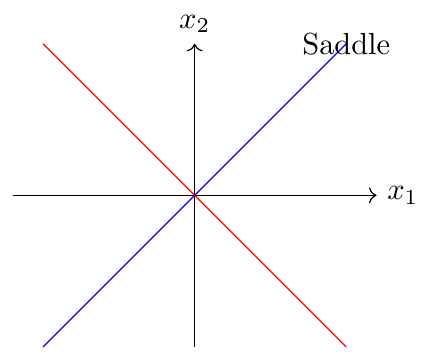
Sketch the surface of $Q(x_1,x_2) = x_1^2 - x_2^2$.
Applications
Quadratic forms are used to:
Test positive/negative definiteness of matrices
Solve constrained optimization problems
Analyze conic sections and 3D surfaces
Diagonalize symmetric matrices (linking to orthogonal transformations)