Limits
Introduction to Calculus
Calculus emerged from the need to solve practical problems in physics and engineering. Two fundamental problems led to its development:
The Tangent Problem: Determining the slope of a line tangent to a curve at a given point.
The Area Problem: Calculating the area under a curve.
The Tangent Problem and Differential Calculus
The rate of change is a critical concept in calculus. To understand this, consider the graphs of the following linear functions:
\( f(x) = -2x - 3 \)
\( g(x) = \frac{x}{2} + 1 \)
\( h(x) = 2 \)
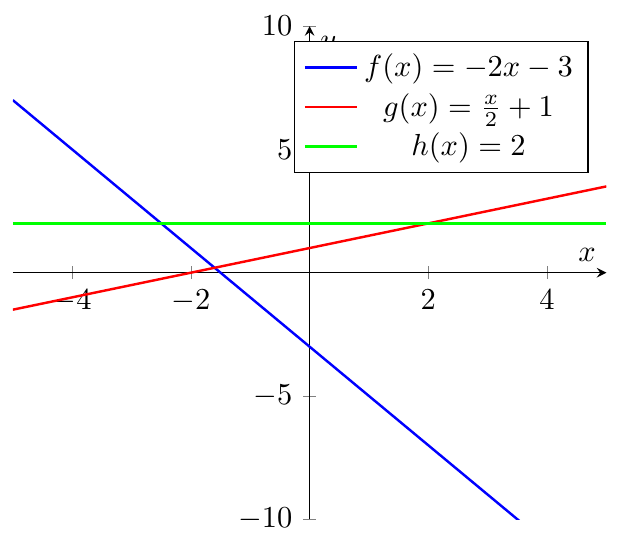
The slope of a linear function indicates the rate of change. For example:
\( f(x) = -2x - 3 \): slope = -2
\( g(x) = \frac{x}{2} + 1 \): slope = 1/2
\( h(x) = 2 \): slope = 0
Now consider the quadratic function \( k(x) = x^2 \). Its rate of change is not constant. To approximate it, we use secant lines.
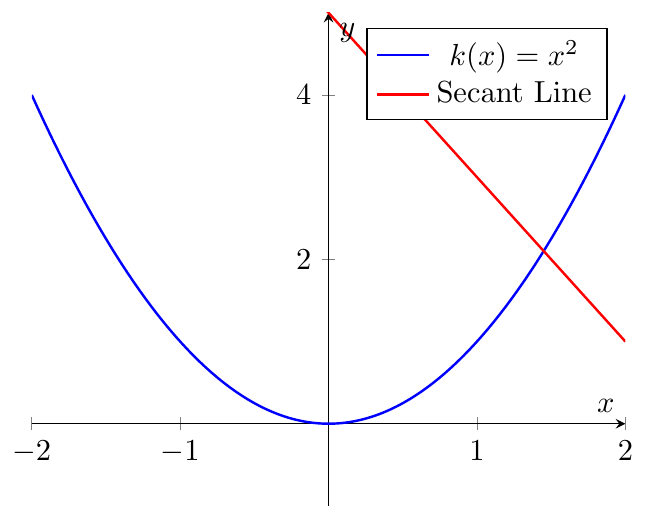
A secant line to a function \( f(x) \) through points \( (a, f(a)) \) and \( (x, f(x)) \) passes through these points. Its slope is \[ m_{\text{sec}} = \frac{f(x) - f(a)}{x - a}. \] As \( x \) approaches \( a \), the secant line approaches the tangent line. Its slope approaches the derivative of \( f(x) \) at \( a \).
Find the slope of the secant line to \( k(x) = x^2 \) through points \( (1,1) \) and \( (2,4) \): \[ m_{\text{sec}} = \frac{4-1}{2-1} = 3. \]
The slope of the tangent line at a point gives the instantaneous rate of change, which is the derivative of the function at that point.
The Area Problem and Integral Calculus
To find the area under a curve, approximate by summing rectangles.
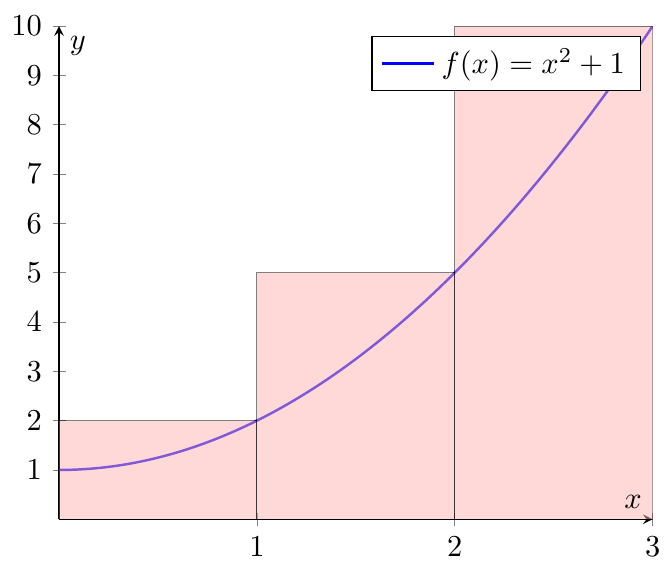
The area under a curve is approximated by summing the areas of rectangles over subintervals. As the width of the rectangles decreases, the sum approaches the exact area. This process leads to the definite integral.
Estimate the area under \( f(x) = x^2 + 1 \) over \( [0,3] \) using three rectangles: \[ \text{Area} \approx \sum_{i=1}^{3} \text{Area of Rectangle}_i \]
Conclusion
The Tangent and Area Problems lead to the foundations of calculus:
Tangent Problem $\rightarrow$ Derivative (rate of change)
Area Problem $\rightarrow$ Integral (area under curve)
These concepts are essential for further studies in calculus and multivariable calculus.
Limits
We say the limit of \(f(x)\) is \(L\) as \(x\) approaches \(a\) and write \[ \lim_{x \to a} f(x) = L \] provided we can make \(f(x)\) as close to \(L\) as we want for all \(x\) sufficiently close to \(a\), from both sides, without actually letting \(x=a\).
The limit describes the behavior of \(f(x)\) around \(x=a\), not necessarily the value at \(x=a\). As \(x\) approaches \(a\), \(f(x)\) must move closer and closer to \(L\). This must hold for values of \(x\) on both sides of \(a\).
Estimating Limits
To estimate limits, we examine the behavior of a function as \(x\) approaches a point \(a\) from both sides. The idea is to find a value \(X\) such that whenever \(|x-a| < X\), the function's value \(f(x)\) stays within a desired tolerance of the limit \(L\).
Estimate \[ \lim_{x \to 3} \frac{x^2 + 5x - 18}{x^2 - 3x}. \]
Although the function is undefined at \(x=3\), we can study its behavior for values near 3.
Define \[ g(x) = \begin{cases} \dfrac{x^2 + 5x - 18}{x^2 - 3x}, & x \neq 3\\ 7, & x=3 \end{cases} \] Estimate \(\lim_{x \to 3} g(x)\).
Answer: As in Example 1, the limit is 4, even though \(g(3) = 7\). This shows that limits depend on nearby values of \(x\), not the function's value at the point itself.
Estimate \[ \lim_{\theta \to 0} \frac{1 - \cos(2\theta)}{\theta}. \]
Observation: The function is undefined at \(\theta = 0\), but by evaluating values close to 0, we can approximate the limit.
Estimate \[ \lim_{t \to 0} \sin(\pi t/2). \]
Observation: Tables of values may help, but they can be misleading. Graphical analysis or algebraic methods provide more reliable estimates.
Estimate \[ \lim_{t \to 0} X(t), \quad X(t) = \begin{cases} -1, & t<0\\ 2, & t \ge 0 \end{cases} \]
Observation: Not all limits exist. Here, the left-hand limit is \(-1\) and the right-hand limit is 2, so the limit does not exist.
Summary
Limits describe the behavior of a function around a point, not necessarily the function's value at that point.
Limits can exist even if the function does not exist at that point.
A function can exist at a point, but its limit at that point might be different.
Tables and graphs can help understand limits but are not always reliable for exact values.
Some limits do not exist.
One-Sided Limits
In the previous section, we saw two limits that did not exist for different reasons:
\(\displaystyle \lim_{t \to 0} \cos(\pi t)\) does not exist because the function oscillates and does not settle to a single value near \(t=0\).
\(\displaystyle \lim_{t \to 0} X(t), \quad X(t)=\begin{cases}0,& t<0\\1,& t\ge 0\end{cases}\) does not exist because the left-hand and right-hand limits are different.
To distinguish these situations, we introduce one-sided limits.
Definitions: One-Sided Limits
We say \[ \lim_{x \to a^+} f(x) = L \] if we can make \(f(x)\) as close to \(L\) as desired for all \(x>a\) sufficiently close to \(a\), without considering \(x=a\).
We say \[ \lim_{x \to a^-} f(x) = L \] if we can make \(f(x)\) as close to \(L\) as desired for all \(x<a\) sufficiently close to \(a\), without considering \(x=a\).
The only difference between one-sided limits and ordinary limits is the direction from which \(x\) approaches \(a\). For a one-sided limit to exist, the function must approach a unique value from that side.
Examples
Estimate: \[ \lim_{t \to 0^+} H(t) \quad \text{and} \quad \lim_{t \to 0^-} H(t), \quad H(t)=\begin{cases}0,& t<0\\1,& t\ge 0\end{cases} \]
Solution: \[ \lim_{t \to 0^+} H(t) = 1, \quad \lim_{t \to 0^-} H(t) = 0 \]
Estimate: \[ \lim_{t \to 0^+} \sin\left(\frac{1}{t}\right) \quad \text{and} \quad \lim_{t \to 0^-} \sin\left(\frac{1}{t}\right) \]
Observation: The function oscillates infinitely near \(t=0\), so the one-sided limits do not exist.
Let \[ g(x) = \begin{cases} \dfrac{x^2 + 5x -18}{x^2 -3x}, & x\neq 3\\ 7, & x=3 \end{cases} \]
Estimate: \[ \lim_{x \to 3^+} g(x) \quad \text{and} \quad \lim_{x \to 3^-} g(x) \]
Solution: Both one-sided limits exist and equal 4.
Fact Relating One-Sided and Ordinary Limits
For a function \(f(x)\):
If \(\lim_{x \to a^+} f(x) = \lim_{x \to a^-} f(x) = L\), then \(\lim_{x \to a} f(x) = L\).
Conversely, if \(\lim_{x \to a} f(x) = L\), both one-sided limits exist and equal \(L\).
If \(\lim_{x \to a^+} f(x) \neq \lim_{x \to a^-} f(x)\), then \(\lim_{x \to a} f(x)\) does not exist.
Properties of Limits
Let \(\lim_{x \to a} f(x)\) and \(\lim_{x \to a} g(x)\) exist, and let \(c\) be any constant. Then the following properties hold:
1. Constant Multiple: \[ \lim_{x \to a} [c f(x)] = c \lim_{x \to a} f(x) \]
Example: \(\lim_{x \to 2} 4x^2 = 4 \cdot 4 = 16\)
2. Sum/Difference: \[ \lim_{x \to a} [f(x) \pm g(x)] = \lim_{x \to a} f(x) \pm \lim_{x \to a} g(x) \]
Example: \(\lim_{x \to 1} (x^2 + 3x) = 1 + 3 = 4\)
3. Product: \[ \lim_{x \to a} [f(x) g(x)] = \lim_{x \to a} f(x) \cdot \lim_{x \to a} g(x) \]
Example: \(\lim_{x \to 2} (x^2 \cdot (x+1)) = 4 \cdot 3 = 12\)
4. Quotient: \[ \lim_{x \to a} \frac{f(x)}{g(x)} = \frac{\lim_{x \to a} f(x)}{\lim_{x \to a} g(x)}, \quad \lim_{x \to a} g(x) \neq 0 \]
Example: \(\lim_{x \to 2} \frac{x^2-4}{x-2} = \lim_{x \to 2} (x+2) = 4\)
5. Power: \[ \lim_{x \to a} [f(x)]^n = [\lim_{x \to a} f(x)]^n \]
Example: \(\lim_{x \to 3} (x-1)^3 = 2^3 = 8\)
6. Root: \[ \lim_{x \to a} \sqrt[n]{f(x)} = \sqrt[n]{\lim_{x \to a} f(x)} \]
Example: \(\lim_{x \to 9} \sqrt{x} = 3\)
7. Constant Function: \(\lim_{x \to a} c = c\)
8. Identity Function: \(\lim_{x \to a} x = a\)
9. Power of Identity: \(\lim_{x \to a} x^n = a^n\)
Infinite Limits
In this section we study limits whose value is \(\infty\) or \(-\infty\). These limits appear frequently in calculus and other exams, so understanding them is essential.
We say \[ \lim_{x \to a} f(x) = \infty \] if we can make \(f(x)\) arbitrarily large for all \(x\) sufficiently close to \(a\) (from both sides) without actually letting \(x = a\).
Similarly, \[ \lim_{x \to a} f(x) = -\infty \] if we can make \(f(x)\) arbitrarily large and negative for all \(x\) sufficiently close to \(a\) without letting \(x = a\).
These definitions can be extended to one-sided limits as well.
A function \(f(x)\) has a vertical asymptote at \(x = a\) if any of the following limits is true: \[ \lim_{x \to a^-} f(x) = \pm \infty, \quad \lim_{x \to a^+} f(x) = \pm \infty, \quad \lim_{x \to a} f(x) = \pm \infty \]
Note: Only one of the above needs to hold.
Let \(f(x)\) and \(g(x)\) be functions such that \[ \lim_{x \to c} f(x) = \infty, \quad \lim_{x \to c} g(x) = L \]
Then: \[ \lim_{x \to c} [f(x) \pm g(x)] = \infty \] \[ \lim_{x \to c} [f(x) g(x)] = \begin{cases} \infty & \text{if } L > 0\\ -\infty & \text{if } L < 0 \end{cases} \] \[ \lim_{x \to c} \frac{g(x)}{f(x)} = 0 \]
Evaluate the following limits: \[ \lim_{x \to 0^+} \frac{1}{x}, \quad \lim_{x \to 0^-} \frac{1}{x}, \quad \lim_{x \to 0} \frac{1}{x} \]
Solution: - As \(x \to 0^+\), \(x>0\) so \(\frac{1}{x} \to +\infty\). - As \(x \to 0^-\), \(x<0\) so \(\frac{1}{x} \to -\infty\). - Since the left and right limits are not equal, \(\lim_{x \to 0} \frac{1}{x}\) does not exist.
Evaluate the following limits: \[ \lim_{x \to 0^+} \frac{6}{x^2}, \quad \lim_{x \to 0^-} \frac{6}{x^2}, \quad \lim_{x \to 0} \frac{6}{x^2} \]
Solution: - As \(x \to 0\), \(x^2>0\) so \(\frac{6}{x^2} \to +\infty\) from both sides. - Therefore, \(\lim_{x \to 0^+} \frac{6}{x^2} = \lim_{x \to 0^-} \frac{6}{x^2} = \lim_{x \to 0} \frac{6}{x^2} = +\infty\)
Evaluate the following limits: \[ \lim_{x \to -2^+} \frac{-4}{x+2}, \quad \lim_{x \to -2^-} \frac{-4}{x+2}, \quad \lim_{x \to -2} \frac{-4}{x+2} \]
Solution: - As \(x \to -2^+\), \(x+2>0\) so \(\frac{-4}{x+2} \to -\infty\). - As \(x \to -2^-\), \(x+2<0\) so \(\frac{-4}{x+2} \to +\infty\). - Left and right limits are not equal, so the limit at \(x=-2\) does not exist.
Evaluate the following limits: \[ \lim_{x \to 4^+} \frac{3}{(4-x)^3}, \quad \lim_{x \to 4^-} \frac{3}{(4-x)^3}, \quad \lim_{x \to 4} \frac{3}{(4-x)^3} \]
Solution: - As \(x \to 4^+\), \(4-x < 0\), so \((4-x)^3 <0\) and \(\frac{3}{(4-x)^3} \to -\infty\). - As \(x \to 4^-\), \(4-x >0\), so \(\frac{3}{(4-x)^3} \to +\infty\). - Since left and right limits differ, \(\lim_{x \to 4} \frac{3}{(4-x)^3}\) does not exist.
Evaluate the following limits: \[ \lim_{x \to 3^+} \frac{2x}{x-3}, \quad \lim_{x \to 3^-} \frac{2x}{x-3}, \quad \lim_{x \to 3} \frac{2x}{x-3} \]
Solution: - As \(x \to 3^+\), \(x-3>0\) so \(\frac{2x}{x-3} \to +\infty\). - As \(x \to 3^-\), \(x-3<0\) so \(\frac{2x}{x-3} \to -\infty\). - Left and right limits differ, so \(\lim_{x \to 3} \frac{2x}{x-3}\) does not exist.
Evaluate the one-sided limit: \[ \lim_{x \to 0^+} \ln x \]
Solution: - As \(x \to 0^+\), \(\ln x \to -\infty\). - So, \(\lim_{x \to 0^+} \ln x = -\infty\)
Evaluate the following limits: \[ \lim_{x \to \pi/2^+} \tan x, \quad \lim_{x \to \pi/2^-} \tan x \]
Solution: - As \(x \to \pi/2^-\), \(\tan x \to +\infty\) - As \(x \to \pi/2^+\), \(\tan x \to -\infty\)
Show that a vertical asymptote exists at \(x=0\) for \(f(x) = 1/x\).
Solution: - One-sided limits: \(\lim_{x\to 0^+} 1/x = +\infty\), \(\lim_{x\to 0^-} 1/x = -\infty\) - Since at least one one-sided limit goes to \(\pm\infty\), \(x=0\) is a vertical asymptote.
Evaluate the following limit: \[ \lim_{x \to 0} \frac{5x+1}{x^2} \]
Solution: - Split: \(\frac{5x+1}{x^2} = \frac{5x}{x^2} + \frac{1}{x^2} = \frac{5}{x} + \frac{1}{x^2}\) - As \(x \to 0^+\), \(\frac{5}{x} + \frac{1}{x^2} \to +\infty\) - As \(x \to 0^-\), \(\frac{5}{x} + \frac{1}{x^2} \to -\infty + \infty = +\infty\) (dominant term \(1/x^2\)) - So, \(\lim_{x \to 0} \frac{5x+1}{x^2} = +\infty\)
Evaluate the following limit: \[ \lim_{x \to -1^+} \frac{2}{x+1}, \quad \lim_{x \to -1^-} \frac{2}{x+1} \]
Solution: - As \(x \to -1^+\), \(x+1>0 \implies \frac{2}{x+1} \to +\infty\) - As \(x \to -1^-\), \(x+1<0 \implies \frac{2}{x+1} \to -\infty\)
Limits at Infinity
By limits at infinity, we study the behavior of functions as \(x\) becomes very large: \[ \lim_{x \to \infty} f(x) \quad \text{or} \quad \lim_{x \to -\infty} f(x) \] These limits may also be \(\infty\) or \(-\infty\).
If \(r > 0\) is rational and \(c\) is a constant: \[ \lim_{x \to \infty} \frac{c}{x^r} = 0, \quad \lim_{x \to -\infty} \frac{c}{x^r} = 0 \quad (\text{if } x^r \text{ defined for } x<0) \] Explanation: As \(x \to \infty\), \(x^r\) grows, making the fraction approach 0. The sign of \(c\) only affects the approach from above or below.
For \(p(x) = a_n x^n + \dots + a_0\), degree \(n\), \(a_n \neq 0\): \[ \lim_{x \to \infty} p(x) = \lim_{x \to \infty} a_n x^n, \quad \lim_{x \to -\infty} p(x) = \lim_{x \to -\infty} a_n x^n \] Explanation: Highest-degree term dominates; lower-degree terms are negligible.
A function \(f(x)\) has a horizontal asymptote at \(y = L\) if: \[ \lim_{x \to \infty} f(x) = L \quad \text{or} \quad \lim_{x \to -\infty} f(x) = L \] Explanation: The graph approaches \(y=L\) as \(x\) moves far from the origin.
\[ \lim_{x \to \infty} (2x^4 - x^2 - 8x), \quad \lim_{t \to -\infty} \left(\frac{1}{3} t^5 + 2 t^3 - t^2 + 8 \right) \]
Solution:
\(\lim_{x \to \infty} (2x^4 - x^2 - 8x) = \infty\) (dominant \(2x^4\)).
\(\lim_{t \to -\infty} (\frac{1}{3} t^5 + \dots) = -\infty\) (dominant \(\frac{1}{3}t^5\) negative).
\[ \lim_{x \to \pm \infty} \frac{2x^4 - x^2 + 8x}{-5x^4 + 7} \]
Solution: Factor \(x^4\): \[ \frac{2 - 1/x^2 + 8/x^3}{-5 + 7/x^4} \to -\frac{2}{5} \quad \text{as } x \to \pm \infty \]
\[ \lim_{x \to \infty} \frac{\sqrt{3x^2 + 6}}{5 - 2x}, \quad \lim_{x \to -\infty} \frac{\sqrt{3x^2 + 6}}{5 - 2x} \]
Solution:
\(x \to \infty: \frac{\sqrt{x^2(3 + 6/x^2)}}{x(-2 + 5/x)} \to -\frac{\sqrt{3}}{2}\)
\(x \to -\infty: \frac{-x\sqrt{3 + 6/x^2}}{x(-2 + 5/x)} \to \frac{\sqrt{3}}{2}\)
\[ \lim_{x \to \infty} e^x = \infty, \quad \lim_{x \to -\infty} e^x = 0, \quad \lim_{x \to \infty} e^{-x} = 0, \quad \lim_{x \to -\infty} e^{-x} = \infty \]
\[ \lim_{x \to \infty} e^{2 - 4x - 8x^2} = 0, \quad \lim_{t \to -\infty} e^{t^4 - 5 t^2 + 1} = \infty, \quad \lim_{z \to 0^+} e^{1/z} = \infty \]
\[ \lim_{x \to \infty} \left(e^{10x} - 4 e^{6x} + \dots \right) = \infty, \quad \lim_{x \to -\infty} \left(e^{10x} - 4 e^{6x} + \dots \right) = -\infty \]
\[ \lim_{x \to 0^+} \ln x = -\infty, \quad \lim_{x \to \infty} \ln x = \infty \]
\[ \lim_{x \to \infty} \ln(7x^3 - x^2 + 1) = \infty, \quad \lim_{t \to -\infty} \ln(t^2 - 5t) = \infty \]
\[ \lim_{x \to \infty} \tan^{-1} x = \frac{\pi}{2}, \quad \lim_{x \to -\infty} \tan^{-1} x = -\frac{\pi}{2} \]
\[ \lim_{x \to \infty} \tan^{-1} x = \frac{\pi}{2}, \quad \lim_{x \to -\infty} \tan^{-1} x = -\frac{\pi}{2}, \quad \lim_{x \to \infty} \tan^{-1}(x^3 - 5x + 6) = \frac{\pi}{2}, \quad \lim_{x \to 0^-} \tan^{-1}\left(\frac{1}{x}\right) = -\frac{\pi}{2} \]
Limit Formulas
$\lim_{x \to a} c = c$
$\lim_{x \to a} x = a$
$\lim_{x \to a} \big(f(x) \pm g(x)\big) = \lim_{x \to a} f(x) \pm \lim_{x \to a} g(x)$
$\lim_{x \to a} \big(f(x) g(x)\big) = \lim_{x \to a} f(x) \cdot \lim_{x \to a} g(x)$
$\lim_{x \to a} \dfrac{f(x)}{g(x)} = \dfrac{\lim_{x \to a} f(x)}{\lim_{x \to a} g(x)}, \; g(a)\neq 0$
$\lim_{x \to \infty} \dfrac{a_n x^n + \cdots}{b_m x^m + \cdots} = \begin{cases} 0, & n < m \\ \dfrac{a_n}{b_m}, & n = m \\ \infty \text{ or } -\infty, & n > m \end{cases}$
$\lim_{x \to a^-} \dfrac{1}{x-a} = -\infty$
$\lim_{x \to a^+} \dfrac{1}{x-a} = +\infty$
$\lim_{x \to 0} \dfrac{\sin x}{x} = 1$
$\lim_{x \to 0} \dfrac{\tan x}{x} = 1$
$\lim_{x \to 0} \dfrac{1 - \cos x}{x^2} = \dfrac{1}{2}$
$\lim_{x \to 0} \dfrac{e^x - 1}{x} = 1$
$\lim_{x \to 0} \dfrac{\ln(1+x)}{x} = 1$
$\lim_{x \to \infty} \left(1 + \dfrac{1}{x}\right)^x = e$
$\lim_{x \to 0^+} x^n \ln x = 0 \quad (n>0)$
$\lim_{x \to \infty} \dfrac{\ln x}{x} = 0$
$\lim_{x \to \infty} \dfrac{x^n}{e^x} = 0$
$\lim_{x \to \infty} \arctan x = \dfrac{\pi}{2}$
$\lim_{x \to -\infty} \arctan x = -\dfrac{\pi}{2}$
$\lim_{x \to 0} \dfrac{\arcsin x}{x} = 1$
$\lim_{x \to 0} \dfrac{\arctan x}{x} = 1$
If $\lim_{x \to a} \dfrac{f(x)}{g(x)}$ is $\dfrac{0}{0}$ or $\dfrac{\infty}{\infty}$, then \[ \lim_{x \to a} \frac{f(x)}{g(x)} = \lim_{x \to a} \frac{f'(x)}{g'(x)}, \quad \text{if the limit exists.} \]
If $f(x) \le g(x) \le h(x)$ and $\lim_{x \to a} f(x) = \lim_{x \to a} h(x) = L$, then $\lim_{x \to a} g(x) = L$
$\lim_{x \to 0^+} x^x = 1$
$\lim_{x \to \infty} \left(1 + \frac{k}{x}\right)^{mx} = e^{km}, \quad k,m \in \mathbb{R}$
$\lim_{x \to \infty} e^{-x} = 0$
$\lim_{x \to -\infty} e^x = 0$
$\lim_{x \to \infty} e^x = \infty$
$\lim_{x \to -\infty} e^{-x} = \infty$
Evaluate \( \lim_{x \to 2} (3x^2 + 5x - 1) \).
Solution: Using the sum and constant multiple properties of limits: \[ \lim_{x \to 2} (3x^2 + 5x - 1) = 3 \lim_{x \to 2} x^2 + 5 \lim_{x \to 2} x - 1 = 3(4) + 5(2) -1 = 21 \]
Evaluate \( \lim_{x \to -1} \frac{x^3 + 1}{x+1} \).
Solution: Factor numerator: \(x^3+1=(x+1)(x^2-x+1)\) \[ \lim_{x \to -1} \frac{(x+1)(x^2-x+1)}{x+1} = \lim_{x \to -1} (x^2-x+1) = 3 \]
Evaluate \( \lim_{x \to 0} \frac{\sqrt{x+4} - 2}{x} \).
Solution: Rationalize the numerator: \[ \frac{\sqrt{x+4}-2}{x} \cdot \frac{\sqrt{x+4}+2}{\sqrt{x+4}+2} = \frac{1}{\sqrt{x+4}+2} \implies \lim_{x \to 0} \frac{1}{4} = \frac{1}{4} \]
Evaluate \( \lim_{x \to 1} \frac{x^2-1}{x-1} \).
Solution: Factor numerator: \(x^2-1=(x-1)(x+1)\) \[ \lim_{x \to 1} \frac{(x-1)(x+1)}{x-1} = \lim_{x \to 1} (x+1) = 2 \]
Evaluate \( \lim_{x \to 0} \frac{1-\cos x}{x^2} \) using \(1-\cos x = 2\sin^2(x/2)\).
Solution: \[ \lim_{x \to 0} \frac{2\sin^2(x/2)}{x^2} = \lim_{x \to 0} 2 \left(\frac{\sin(x/2)}{x}\right)^2 = 2\left(\frac{1}{2}\right)^2 = \frac{1}{2} \]
Evaluate \( \lim_{x \to 4} \sqrt{x} \).
Solution: Using the root property: \[ \lim_{x \to 4} \sqrt{x} = \sqrt{\lim_{x \to 4} x} = 2 \]
Evaluate \( \lim_{x \to 0} \frac{\sin 3x}{x} \).
Solution: Factor 3: \[ \lim_{x \to 0} \frac{\sin 3x}{x} = 3 \lim_{x \to 0} \frac{\sin 3x}{3x} = 3(1) = 3 \]
Evaluate \( \lim_{x \to 0} \frac{\tan x}{x} \).
Solution: Standard limit property: \[ \lim_{x \to 0} \frac{\tan x}{x} = 1 \]
Evaluate \( \lim_{x \to 1} \frac{x^4-1}{x-1} \).
Solution: Factor numerator: \(x^4-1 = (x-1)(x^3+x^2+x+1)\) \[ \lim_{x \to 1} \frac{(x-1)(x^3+x^2+x+1)}{x-1} = \lim_{x \to 1} (x^3+x^2+x+1) = 4 \]
Evaluate \( \lim_{x \to 2} \frac{x^2-4}{x^2+4} \).
Solution: Factor numerator: \(x^2-4=(x-2)(x+2)\) \[ \lim_{x \to 2} \frac{(x-2)(x+2)}{x^2+4} = \frac{4}{8} = \frac{1}{2} \]
Evaluate \( \lim_{x \to 0} \frac{e^x-1}{x} \).
Solution: Standard exponential limit: \[ \lim_{x \to 0} \frac{e^x-1}{x} = 1 \]
Evaluate \( \lim_{x \to 0} \frac{\ln(1+x)}{x} \).
Solution: Standard logarithmic limit: \[ \lim_{x \to 0} \frac{\ln(1+x)}{x} = 1 \]
Evaluate \( \lim_{x \to 1} \frac{\sqrt{x}-1}{x-1} \).
Solution: Rationalize numerator: \[ \frac{\sqrt{x}-1}{x-1} \cdot \frac{\sqrt{x}+1}{\sqrt{x}+1} = \frac{1}{\sqrt{x}+1} \implies \lim_{x \to 1} \frac{1}{2} = \frac{1}{2} \]
Evaluate \( \lim_{x \to 0} \frac{\sin x + \tan x}{x} \).
Solution: Split limit: \[ \lim_{x \to 0} \frac{\sin x}{x} + \lim_{x \to 0} \frac{\tan x}{x} = 1 + 1 = 2 \]
Evaluate \( \lim_{x \to 0^+} \ln x \).
Solution: As \(x \to 0^+\), \(\ln x \to -\infty\)
Evaluate \( \lim_{x \to \infty} \frac{3x^2+2}{5x^2-7} \).
Solution: Divide numerator and denominator by \(x^2\): \[ \lim_{x \to \infty} \frac{3+2/x^2}{5-7/x^2} = \frac{3}{5} \]
Evaluate \( \lim_{x \to 0} \frac{1}{x} \).
Solution: Limit does not exist; as \(x \to 0^+\), it \(\to \infty\); as \(x \to 0^-\), it \(\to -\infty\)
Evaluate \( \lim_{x \to 0} \frac{\sin 2x}{\sin 3x} \).
Solution: Rewrite: \[ \lim_{x \to 0} \frac{2x}{3x} \cdot \frac{\sin 2x/(2x)}{\sin 3x/(3x)} = \frac{2}{3} \cdot 1 = \frac{2}{3} \]
Evaluate \( \lim_{x \to 1} (x^5 - 1) \).
Solution: Direct substitution: \[ \lim_{x \to 1} (x^5-1) = 1-1=0 \]
Evaluate \( \lim_{x \to 0} \frac{e^{2x}-1}{\sin x} \).
Solution: Split and use standard limits: \[ \lim_{x \to 0} \frac{e^{2x}-1}{x} \cdot \frac{x}{\sin x} = 2 \cdot 1 = 2 \]