Differentiability
Derivatives
The derivative of a function $f(x)$ at a point $x = a$ measures the instantaneous rate of change of the function at that point. It is defined as: \[ f'(a) = \lim_{h \to 0} \frac{f(a+h) - f(a)}{h} \] if the limit exists.
Geometrically, the derivative represents the slope of the tangent line to the curve $y = f(x)$ at $x = a$.
If $f'(a) > 0$, the function is increasing at $x = a$.
If $f'(a) < 0$, the function is decreasing at $x = a$.
If $f'(a) = 0$, the function may have a local maximum, minimum, or horizontal inflection at $x = a$.
Examples of Derivatives
{Derivative of a Polynomial} Find the derivative of $f(x) = 3x^3 - 5x^2 + 2x - 7$.
Solution: Using the power rule $\frac{d}{dx}[x^n] = nx^{n-1}$: \[ f'(x) = 9x^2 - 10x + 2 \]
{Derivative of a Trigonometric Function} Find the derivative of $f(x) = \sin x + \cos x$.
Solution: Using standard derivatives $\frac{d}{dx}\sin x = \cos x$ and $\frac{d}{dx}\cos x = -\sin x$: \[ f'(x) = \cos x - \sin x \]
{Derivative of an Exponential Function} Find the derivative of $f(x) = e^{2x}$.
Solution: Using $\frac{d}{dx} e^{u} = e^u \frac{du}{dx}$, here $u = 2x$, $\frac{du}{dx}=2$: \[ f'(x) = 2 e^{2x} \]
{Derivative of a Rational Function} Find the derivative of $f(x) = \frac{1}{x^2}$.
Solution: Rewrite $f(x) = x^{-2}$, then use the power rule: \[ f'(x) = -2 x^{-3} = -\frac{2}{x^3} \]
{Derivative Using the Definition} Find the derivative of $f(x) = x^2$ at $x = 3$ using the definition: \[ f'(a) = \lim_{h \to 0} \frac{f(a+h)-f(a)}{h} \]
Solution: Let $a = 3$: \[ f'(3) = \lim_{h \to 0} \frac{(3+h)^2 - 9}{h} = \lim_{h \to 0} \frac{9 + 6h + h^2 - 9}{h} = \lim_{h \to 0} \frac{6h + h^2}{h} = \lim_{h \to 0} (6 + h) = 6 \]
Differentiability
A function $f(x)$ is said to be differentiable at a point $x = a$ if its derivative exists at that point: \[ f'(a) = \lim_{h \to 0} \frac{f(a+h) - f(a)}{h} \quad \text{exists.} \]
Key Points:
If $f$ is differentiable at $x = a$, then it is continuous at $x = a$.
The converse is not necessarily true: continuity at $x = a$ does not guarantee differentiability.
Geometrically, differentiability means the function has a well-defined tangent at $x = a$.
The derivative $f'(a)$ represents the slope of the tangent line at $x = a$.
If the curve has a sharp corner or cusp at $x = a$, it is not differentiable.
If the curve has a vertical tangent, $f'(a)$ does not exist, so the function is not differentiable there.
Checking Differentiability at a Point
To check if $f(x)$ is differentiable at $x=a$:
Check if $f(x)$ is continuous at $x=a$.
Compute the left-hand derivative: \[ f'_-(a) = \lim_{h \to 0^-} \frac{f(a+h) - f(a)}{h} \]
Compute the right-hand derivative: \[ f'_+(a) = \lim_{h \to 0^+} \frac{f(a+h) - f(a)}{h} \]
If $f'_-(a) = f'_+(a)$ (finite), then $f$ is differentiable at $x=a$. Otherwise, it is not.
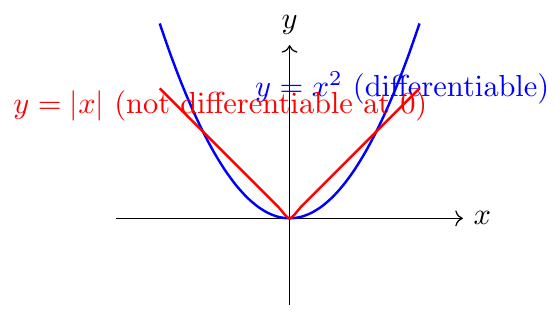
Continuity: $|x|$ is continuous at $0$.
Left derivative: \[ f'_-(0) = \lim_{h \to 0^-} \frac{|h|}{h} = -1 \] Right derivative: \[ f'_+(0) = \lim_{h \to 0^+} \frac{|h|}{h} = 1 \] Since $f'_-(0) \neq f'_+(0)$, $f(x)$ is not differentiable at $0$.
Continuity: $x^2$ is continuous everywhere.
Both derivatives: \[ f'(2) = \lim_{h \to 0} \frac{(2+h)^2 - 4}{h} = \lim_{h \to 0}(4+h) = 4 \] Thus, $f(x)$ is differentiable at $x=2$ with slope $4$.
Visualizing Differentiability
Continuity: $\sqrt{|x|}$ is continuous at $0$.
Left derivative: \[ f'_-(0) = \lim_{h \to 0^-} \frac{\sqrt{-h}}{h} = -\infty \] Right derivative: \[ f'_+(0) = \lim_{h \to 0^+} \frac{\sqrt{h}}{h} = +\infty \] Since derivatives diverge, $f(x)$ is not differentiable at $0$.
\[ f(x) = \begin{cases} x^2, & x \leq 1 \\ 2x-1, & x > 1 \end{cases} \]
Continuity at $x=1$: From left: $f(1^-)=1$, from right: $f(1^+)=1$. Continuous.
Left derivative: \[ f'_-(1) = \lim_{h \to 0^-} \frac{(1+h)^2-1}{h} = 2 \] Right derivative: \[ f'_+(1) = \lim_{h \to 0^+} \frac{(2(1+h)-1)-1}{h} = 2 \] Since $f'_-(1)=f'_+(1)=2$, $f$ is differentiable at $x=1$.
{Differentiable Trigonometric Function} Consider $f(x) = \sin x$.
Solution: $f'(x) = \cos x$, which exists for all $x \in \mathbb{R}$.
Conclusion: Differentiable everywhere.