Continuity
Continuity of Functions
A function $f(x)$ is continuous at a point $a$ if the following three conditions hold:
$f(a)$ is defined.
$\lim_{x \to a} f(x)$ exists.
$\lim_{x \to a} f(x) = f(a)$.
If any condition fails, $f$ is discontinuous at $a$.
Verify that $f(a)$ exists.
Compute $\lim_{x \to a} f(x)$, including left- and right-hand limits if needed.
Compare $f(a)$ with the limit. Equality confirms continuity.
{Continuity at a Point} Determine if $f(x) = \frac{x^2-1}{x-1}$ is continuous at $x=1$.
Solution: $f(1)$ is undefined since denominator $x-1=0$.
Conclusion: $f$ is discontinuous at $x=1$ (removable discontinuity).
{Continuity at a Point} Determine if \[ f(x) = \begin{cases} x^2, & x \neq 2 \\ 5, & x = 2 \end{cases} \] is continuous at $x=2$.
Solution: $\lim_{x \to 2} f(x) = \lim_{x \to 2} x^2 = 4$. $f(2) = 5 \neq 4$.
Conclusion: $f$ is discontinuous at $x=2$ (removable discontinuity).
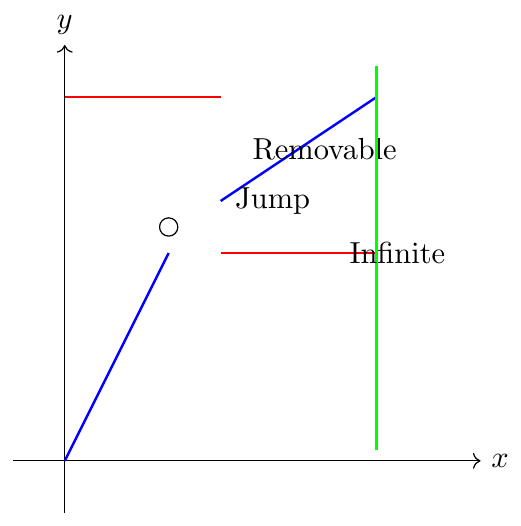
Types of Discontinuities
Removable: Limit exists but $f(a) \neq \lim_{x \to a} f(x)$.
Jump: $\lim_{x \to a^-} f(x) \neq \lim_{x \to a^+} f(x)$.
Infinite: $\lim_{x \to a^-} f(x) = \pm \infty$ or $\lim_{x \to a^+} f(x) = \pm \infty$.
Continuity over an Interval
Continuous from right at $a$: $\lim_{x \to a^+} f(x) = f(a)$
Continuous from left at $a$: $\lim_{x \to a^-} f(x) = f(a)$
Continuous on $(a,b)$: Continuous at every point in $(a,b)$
Continuous on $[a,b]$: Continuous on $(a,b)$, right-continuous at $a$, left-continuous at $b$
{Continuity on Interval} Find intervals of continuity for $f(x) = \frac{x+2}{x^2-1}$.
Solution: Denominator zero when $x^2-1 = 0 \implies x = \pm 1$.
Answer: $(-\infty,-1) \cup (-1,1) \cup (1,\infty)$
{Continuity on Interval} Find intervals of continuity for $f(x) = \sqrt{9-x^2}$.
Solution: Inside square root $\ge 0 \implies 9-x^2 \ge 0 \implies -3 \le x \le 3$.
Answer: $[-3,3]$
Composite Functions and Trigonometric Continuity
If $f(x)$ is continuous at $L$ and $\lim_{x \to a} g(x) = L$, then \[ \lim_{x \to a} f(g(x)) = f\left(\lim_{x \to a} g(x)\right) = f(L) \]
{Limit of a Composite Function} Evaluate $\lim_{x \to 0} \sin(3x)$.
Solution: Let $g(x)=3x$, $\lim_{x\to 0} g(x)=0$, and $\sin$ is continuous at 0. \[ \lim_{x \to 0} \sin(3x) = \sin(0) = 0 \]
$\sin x$, $\cos x$, $\tan x$, $\cot x$, $\sec x$, $\csc x$ are continuous on their domains.
Intermediate Value Theorem (IVT)
If $f$ is continuous on $[a,b]$ and $z$ lies between $f(a)$ and $f(b)$, then $\exists c \in (a,b)$ such that $f(c)=z$.
{Application of IVT} Show that $f(x) = x^3 - x - 2$ has a root in $[1,2]$.
Solution: \[ f(1) = 1 -1 -2 = -2 < 0, \quad f(2) = 8 -2 -2 = 4 >0 \] $f$ is continuous (polynomial). By IVT, $\exists c \in (1,2)$ with $f(c)=0$.
{Root Existence Using IVT} Show that $f(x) = \cos x - x$ has a root in $[0,1]$.
Solution: \[ f(0) = 1 - 0 = 1 > 0, \quad f(1) = \cos 1 -1 \approx 0.5403 -1 = -0.4597 <0 \] $f$ is continuous (trig function). IVT guarantees $\exists c \in (0,1)$ with $f(c)=0$.