Optimization (Maxima/Minima)
Rate of Change
Derivatives as Rates of Change
One of the fundamental interpretations of the derivative is that it measures the rate of change of a function. Specifically, if $f(x)$ represents a quantity that depends on $x$, then the derivative $f'(x)$ tells us how rapidly $f(x)$ is changing with respect to $x$ at any given point.
This idea is widely applicable in physics, engineering, and economics, for example, in measuring velocity as the rate of change of position, growth rates in populations, or marginal cost in economics.
Examples of Rate of Change
{Velocity of a Moving Particle} The position of a particle is given by $s(t) = 5t^2 + 2t$. Find its velocity at $t = 3$ seconds.
Solution: Velocity is the derivative of position: \[ v(t) = s'(t) = \frac{d}{dt}(5t^2 + 2t) = 10t + 2 \] At $t=3$: \[ v(3) = 10(3) + 2 = 32 \text{ units/sec} \]
{Marginal Cost} The cost (in dollars) of producing $x$ units of a product is $C(x) = 50 + 4x + 0.1x^2$. Find the marginal cost when $x=20$ units.
Solution: Marginal cost is the derivative of the total cost: \[ C'(x) = \frac{d}{dx} (50 + 4x + 0.1x^2) = 4 + 0.2x \] At $x=20$: \[ C'(20) = 4 + 0.2(20) = 4 + 4 = 8 \text{ dollars/unit} \]
{Rate of Change of Temperature} The temperature of a cup of coffee at time $t$ minutes is modeled by $T(t) = 80 - 5\ln(t+1)$. Find the rate at which the temperature is decreasing at $t=4$ minutes.
Solution: Rate of change of temperature: \[ T'(t) = \frac{d}{dt} \left(80 - 5\ln(t+1)\right) = -\frac{5}{t+1} \] At $t=4$: \[ T'(4) = -\frac{5}{5} = -1 \text{ degree/minute} \] Conclusion: The coffee is cooling at 1 degree per minute at $t=4$.
{Rate of Change of Area} The side of a square grows with time according to $s(t) = 3t + 2$ meters. Find the rate at which the area of the square changes at $t=2$ seconds.
Solution: Area $A = s^2$, so \[ \frac{dA}{dt} = 2s \cdot \frac{ds}{dt} = 2(3t+2) \cdot 3 = 6(3t+2) \] At $t=2$: \[ \frac{dA}{dt} = 6(6+2) = 6 \cdot 8 = 48 \text{ m}^2/\text{sec} \]
The derivative is a versatile tool to calculate instantaneous rates of change in various contexts: motion, economics, population dynamics, temperature, and geometric growth. Recognizing the connection between the function and its derivative allows us to model real-world phenomena effectively.
Critical Points
Let $f(x)$ be a function defined on some interval. A point $x=c$ is called a critical point of $f(x)$ if:
$f(c)$ exists, and
either $f'(c) = 0$ or $f'(c)$ does not exist.
Critical points indicate where a function may have:
a local maximum,
a local minimum,
or a saddle point (point of inflection where derivative is $0$ but no extremum).
Note: Finding critical points is only the first step. To classify them as max/min/saddle, one usually applies the First Derivative Test or the Second Derivative Test.
Examples
Determine all critical points of \[ f(x) = 4x^3 - 12x^2 + 7x + 5 \]
Solution: Derivative: \[ f'(x) = 12x^2 - 24x + 7 \] Set $f'(x) = 0$: \[ 12x^2 - 24x + 7 = 0 \implies x = 1 \pm \tfrac{\sqrt{15}}{6} \]
Conclusion: Critical points are $x = 1 \pm \tfrac{\sqrt{15}}{6}$.
Find the critical points of \[ g(t) = \sqrt{t}(t-2), \quad t \geq 0 \]
Solution: Derivative: \[ g'(t) = \frac{1}{2\sqrt{t}}(t-2) + \sqrt{t} = \frac{3t-2}{2\sqrt{t}} \]
Set $g'(t)=0$: \[ 3t-2=0 \implies t=\tfrac{2}{3} \]
Also, $g'(t)$ undefined at $t=0$ (but $g(0)=0$ exists).
Conclusion: Critical points are $t=0$ and $t=\tfrac{2}{3}$.
Find the critical points of \[ y = 5x - 3\sin(2x) \]
Solution: Derivative: \[ y' = 5 - 6\cos(2x) \]
Set $y'=0$: \[ \cos(2x)=\tfrac{5}{6} \]
Conclusion: Infinite critical points: \[ x=\tfrac{1}{2}\cos^{-1}\!\left(\tfrac{5}{6}\right)+n\pi,\quad n\in\mathbb{Z} \]
Determine all critical points of \[ h(t) = t e^{-t^2} \]
Solution: Derivative: \[ h'(t)=e^{-t^2}(1-2t^2) \]
Set $h'(t)=0$: \[ 1-2t^2=0 \implies t=\pm \tfrac{1}{\sqrt{2}} \]
Conclusion: Critical points at $t=\pm \tfrac{1}{\sqrt{2}}$.
Find critical points of \[ f(x)=x^2 \ln(x),\quad x>0 \]
Solution: Derivative: \[ f'(x)=2x\ln x + x = x(2\ln x+1) \]
Set $f'(x)=0$: $x=0$ (not in domain), or $\ln x=-\tfrac{1}{2} \implies x=e^{-1/2}$.
Conclusion: Critical point at $x=e^{-1/2}$.
Determine all critical points of \[ f(x)=x e^{x^2} \]
Solution: Derivative: \[ f'(x)=e^{x^2}(1+2x^2) \]
Since $e^{x^2}>0$ for all $x$, we need $1+2x^2=0$, which has no real solution.
Conclusion: No critical points in the real domain.
Critical points arise when:
$f'(x)=0$ (possible max, min, or saddle point),
$f'(x)$ does not exist (but $f(x)$ is defined).
Important:
Critical points do not guarantee maxima or minima.
Example: $f(x)=x^3$ has a critical point at $x=0$ which is a saddle point.
To classify, use the First Derivative Test or Second Derivative Test.
Minima and Maxima
Maximum and Minimum Values of a Function
Let $f(x)$ be a function defined on a domain $D$.
$f(x)$ has an absolute (global) maximum at $x=c$ if \[ f(c) \ge f(x) \quad \forall x \in D \]
$f(x)$ has a absolute (global) minimum at $x=c$ if \[ f(c) \le f(x) \quad \forall x \in D \]
$f(x)$ has a relative (local) maximum at $x=c$ if $f(c) \ge f(x)$ for all $x$ in some open interval around $c$.
$f(x)$ has a relative (local) minimum at $x=c$ if $f(c) \le f(x)$ for all $x$ in some open interval around $c$.
Notes:
Relative extrema occur interior to the domain, not at endpoints.
Absolute extrema may occur at endpoints or at relative extrema inside the domain.
The extrema of a function refer collectively to all maximum and minimum values:
Relative extrema = local maximums and minimums
Absolute extrema = global maximums and minimums
Examples
{Quadratic Function on a Closed Interval}
Find the absolute and relative extrema of
\[
f(x) = x^2 - 4x + 3 \quad \text{on } [0,3]
\]
Solution:
Derivative: $f'(x) = 2x - 4$.
Set $f'(x)=0 \implies 2x-4=0 \implies x=2$ (critical point).
Check endpoints and critical point: \[ f(0)=3, \quad f(2) = -1, \quad f(3)=0 \]
Conclusion: Absolute maximum = $f(0)=3$, Absolute minimum = $f(2)=-1$, Relative minimum = $f(2)=-1$, Relative maximum = $f(0)=3$ (endpoint, only absolute).
{Cubic Function on a Closed Interval}
Find absolute and relative extrema of
\[
f(x) = x^3 - 3x^2 + 2 \quad \text{on } [-1,2]
\]
Solution:
Derivative: $f'(x) = 3x^2 - 6x = 3x(x-2)$.
Critical points: $x=0,2$
Check endpoints and critical points: \[ f(-1) = -2, \quad f(0)=2, \quad f(2)= -2 \]
Conclusion: Absolute maximum = $f(0)=2$, Absolute minimum = $f(-1) = -2$ (also occurs at $x=2$), Relative maximum = $f(0)=2$, Relative minimum = none in interior.
{Trigonometric Function}
Find extrema of
\[
f(x) = \sin x \quad \text{on } [0,2\pi]
\]
Solution:
Derivative: $f'(x) = \cos x$.
Set $f'(x)=0 \implies \cos x = 0 \implies x = \frac{\pi}{2}, \frac{3\pi}{2}$
Check endpoints and critical points: \[ f(0)=0, f(2\pi)=0, f(\pi/2)=1, f(3\pi/2)=-1 \]
Conclusion: Absolute maximum = 1 at $x=\pi/2$, Absolute minimum = -1 at $x=3\pi/2$, Relative maximum = 1 at $x=\pi/2$, Relative minimum = -1 at $x=3\pi/2$.
{Function with No Relative Extrema}
\[
f(x) = x^3 \quad \text{on } [-2,2]
\]
Solution:
Derivative: $f'(x)=3x^2=0 \implies x=0$
Check second derivative or graph: $f”(x)=6x$ At $x=0$, $f”(0)=0$ → inflection point, not maximum or minimum
Check endpoints for absolute extrema: $f(-2)=-8, f(2)=8$
Conclusion: Absolute maximum = 8 at $x=2$, Absolute minimum = -8 at $x=-2$, No relative extrema.
Important Theorems
If $f(x)$ is continuous on a closed interval $[a,b]$, then there exist $c,d \in [a,b]$ such that $f(c)$ is an absolute maximum and $f(d)$ is an absolute minimum.
If $f(x)$ has a relative extrema at $x=c$ and $f'(c)$ exists, then $x=c$ is a critical point of $f(x)$, i.e., $f'(c)=0$.
Not all critical points are relative extrema (e.g., $f(x)=x^3$ at $x=0$).
Relative extrema can also occur at critical points where $f'(c)$ does not exist (e.g., $f(x)=|x|$ at $x=0$).
Absolute extrema may or may not occur at critical points; endpoints must also be checked.
Absolute Extrema
Finding Absolute Extrema on a Closed Interval
When a function $f(x)$ is continuous on a closed interval $[a,b]$, the Extreme Value Theorem guarantees that $f(x)$ attains both an absolute maximum and an absolute minimum somewhere in the interval. These extrema can occur either at the endpoints or at the critical points of the function.
To find the absolute extrema of $f(x)$ on $[a,b]$:
Verify that $f(x)$ is continuous on $[a,b]$.
Find all critical points $c$ in $(a,b)$ where $f'(c)=0$ or $f'(c)$ does not exist.
Evaluate $f(x)$ at all critical points and at the endpoints $x=a$ and $x=b$.
Identify the largest and smallest values; these are the absolute maximum and absolute minimum, respectively.
Only critical points inside the interval matter; critical points outside the interval should be ignored.
Absolute extrema can occur at either critical points or endpoints.
A small change in the interval may change which points are the absolute extrema.
Examples
{Polynomial Function on a Closed Interval}
Find the absolute extrema of
\[
f(x) = x^3 - 6x^2 + 9x + 1 \quad \text{on } [0,4]
\]
Solution:
Derivative: $f'(x) = 3x^2 - 12x + 9 = 3(x^2 - 4x + 3) = 3(x-1)(x-3)$
Critical points in $[0,4]$: $x=1,3$
Evaluate $f(x)$ at endpoints and critical points: \[ f(0)=1, \quad f(1)=5, \quad f(3)=1, \quad f(4)=1 \]
Conclusion: Absolute maximum = $f(1)=5$, Absolute minimum = $f(0)=f(3)=f(4)=1$
{Cubic Function with Restricted Interval}
Find the absolute extrema of
\[
f(x) = 2x^3 - 9x^2 + 12x + 5 \quad \text{on } [1,3]
\]
Solution:
Derivative: $f'(x) = 6x^2 - 18x + 12 = 6(x^2 -3x + 2) = 6(x-1)(x-2)$
Critical points in $[1,3]$: $x=1,2$ (ignore $x=1$ if already endpoint)
Evaluate $f(x)$ at endpoints and critical points: \[ f(1)=10, \quad f(2)=8, \quad f(3)=11 \]
Conclusion: Absolute maximum = $f(3)=11$, Absolute minimum = $f(2)=8$
{Trigonometric Function}
Determine the minimum and maximum values of
\[
f(t) = \sin(2t) + t \quad \text{on } [0, \pi]
\]
Solution:
Derivative: $f'(t) = 2\cos(2t) + 1$
Set $f'(t)=0 \implies 2\cos(2t)+1=0 \implies \cos(2t)=-\frac{1}{2} \implies 2t = \frac{2\pi}{3}, \frac{4\pi}{3} \implies t = \frac{\pi}{3}, \frac{2\pi}{3}$
Evaluate at critical points and endpoints: \[ f(0)=0, \quad f(\pi)=\pi, \quad f(\pi/3) = \frac{\sqrt{3}}{2} + \frac{\pi}{3}, \quad f(2\pi/3) = -\frac{\sqrt{3}}{2} + \frac{2\pi}{3} \]
Conclusion: Absolute maximum = $f(\pi) = \pi$, Absolute minimum = $f(0)=0$
{Exponential Function}
Find the extrema of
\[
f(x) = x e^{-x^2} \quad \text{on } [-2,2]
\]
Solution:
Derivative: $f'(x) = e^{-x^2} - 2x^2 e^{-x^2} = e^{-x^2}(1-2x^2)$
Critical points: $1-2x^2=0 \implies x=\pm \frac{1}{\sqrt{2}}$
Evaluate at endpoints and critical points: \[ f(-2) \approx -0.036, \quad f(2)\approx 0.036, \quad f(\pm 1/\sqrt{2}) = \pm 0.43 \]
Conclusion: Absolute maximum $\approx 0.43$ at $x=1/\sqrt{2}$, Absolute minimum $\approx -0.43$ at $x=-1/\sqrt{2}$
{Function with Nonexistent Derivative at Critical Point}
Determine extrema of
\[
f(x) = |x-1| \quad \text{on } [0,3]
\]
Solution:
Derivative does not exist at $x=1$ (critical point).
Evaluate endpoints and critical point: \[ f(0)=1, \quad f(1)=0, \quad f(3)=2 \]
Conclusion: Absolute maximum = $f(3)=2$, Absolute minimum = $f(1)=0$
Increasing/Decreasing and Concavity/Convexity
- A function $f(x)$ is increasing on an interval if $f'(x) > 0$ for all $x$ in that interval.
- A function $f(x)$ is decreasing on an interval if $f'(x) < 0$ for all $x$ in that interval.
Procedure:
1. Compute $f'(x)$.
2. Solve $f'(x) = 0$ to find critical points.
3. Test intervals between critical points to determine sign of $f'(x)$.
- A function $f(x)$ is concave up (convex) if $f”(x) > 0$.
- A function $f(x)$ is concave down if $f”(x) < 0$.
- Inflection points occur where $f”(x)=0$ and concavity changes.
Procedure:
1. Compute $f”(x)$.
2. Solve $f”(x)=0$.
3. Test intervals to see where $f”(x)$ is positive or negative.
Let $f(x) = x^3 - 3x^2 + 2$.
Compute derivative: $f'(x) = 3x^2 - 6x = 3x(x-2)$.
Critical points: $x=0,2$.
Test intervals:
- $(-\infty,0)$: $f'(x)>0$ → increasing
- $(0,2)$: $f'(x)<0$ → decreasing
- $(2,\infty)$: $f'(x)>0$ → increasing
Let $f(x) = x^3 - 3x^2 + 2$.
Second derivative: $f”(x) = 6x - 6$.
Set $f”(x)=0 \implies x=1$.
Test intervals:
- $(-\infty,1)$: $f”(x)<0$ → concave down
- $(1,\infty)$: $f”(x)>0$ → concave up.
Inflection point at $x=1$.
Mean Value Theorem
Rolle's Theorem
Theorem (Rolle's Theorem): Let $f(x)$ be a function satisfying:
$f(x)$ is continuous on the closed interval $[a,b]$,
$f(x)$ is differentiable on the open interval $(a,b)$,
$f(a) = f(b)$.
Then there exists at least one number $c \in (a,b)$ such that \[ f'(c) = 0 \] or equivalently, $f(x)$ has a critical point in $(a,b)$.
{Application of Rolle's Theorem}
Show that $f(x) = x^3 - 3x + 2$ has at least one critical point in $[-2,2]$.
solution:
Check the conditions:
$f(x)$ is a polynomial $\implies$ continuous and differentiable everywhere.
$f(-2) = (-8) + 6 + 2 = 0$, $f(2) = 8 - 6 + 2 = 4$. Since $f(-2) \neq f(2)$, Rolle's Theorem cannot be applied here directly.
Instead, if we pick interval $[0,1]$, $f(0)=2$, $f(1)=0$. Then we can adjust and check other intervals for equal values. The key point: Rolle's Theorem ensures that whenever $f(a) = f(b)$, there exists a $c$ with $f'(c)=0$.
Mean Value Theorem (MVT)
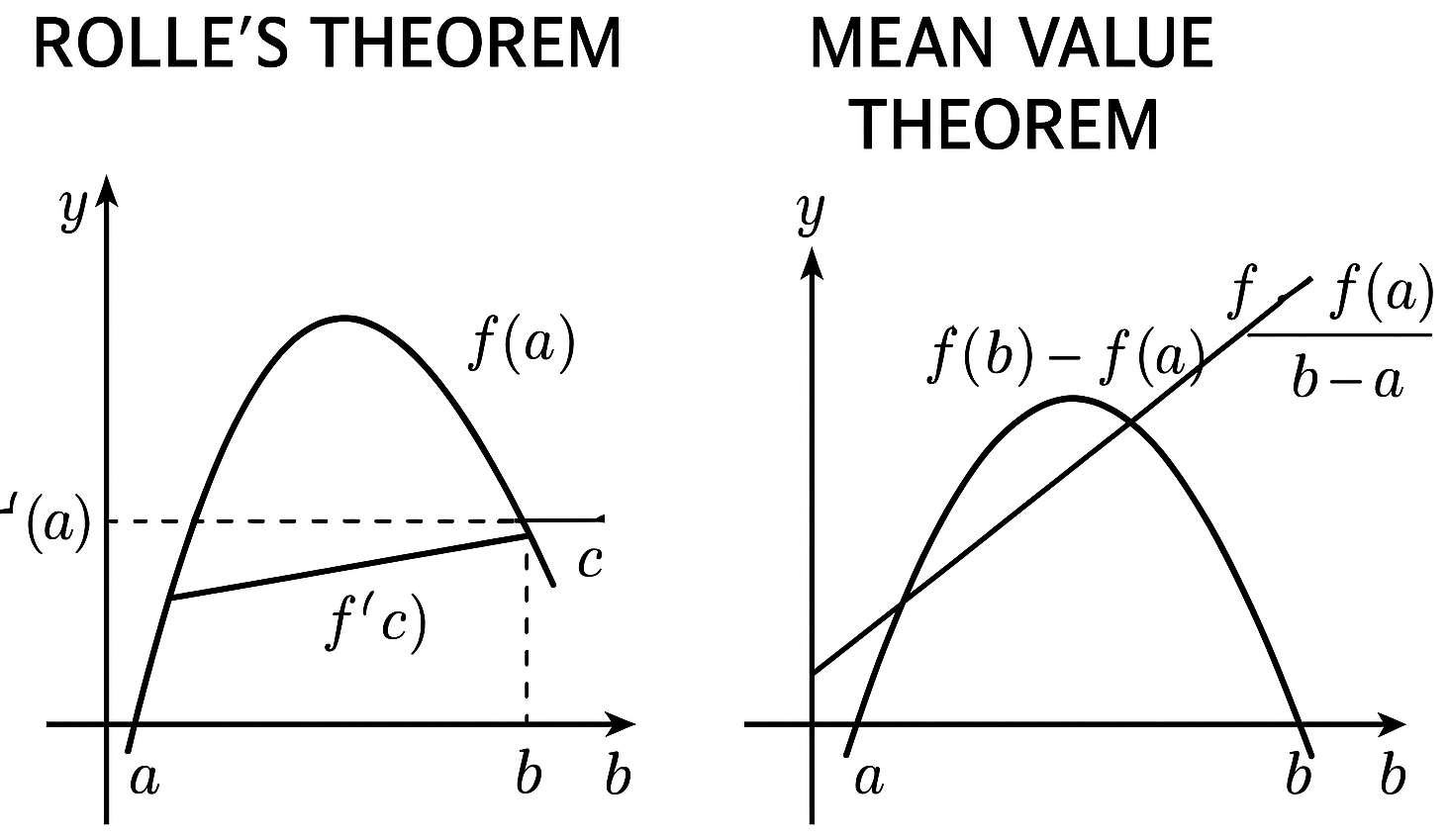
Theorem (MVT): If $f(x)$ is continuous on $[a,b]$ and differentiable on $(a,b)$, then there exists at least one $c \in (a,b)$ such that \[ f'(c) = \frac{f(b)-f(a)}{b-a}. \]
The Mean Value Theorem states that there exists at least one point $c$ where the tangent to the curve is parallel to the secant line connecting $(a,f(a))$ and $(b,f(b))$.
{Using MVT}
Find all $c$ that satisfy the conclusion of MVT for
\[
f(x) = x^3 - x \quad \text{on } [0,2].
\]
Solution:
Slope of secant:
\[
\frac{f(2)-f(0)}{2-0} = \frac{6-0}{2} = 3
\]
Derivative: $f'(x) = 3x^2 - 1$
Set $f'(c) = 3 \implies 3c^2 - 1 = 3 \implies 3c^2 = 4 \implies c = \frac{2}{\sqrt{3}} \approx 1.155$
{Bounding Function Values Using MVT}
Suppose $f(x)$ is continuous and differentiable on $[1,5]$, with $f'(x) \le 4$ and $f(1)=3$. What is the largest possible value of $f(5)$?
Solution:
By MVT, for some $c \in (1,5)$:
\[
f'(c) = \frac{f(5)-f(1)}{5-1} \le 4 \implies \frac{f(5)-3}{4} \le 4 \implies f(5) \le 19
\]
Conclusion: Maximum possible $f(5) = 19$
Applications of MVT
If $f'(x) = 0$ for all $x$ in $(a,b)$, then $f(x)$ is constant on $(a,b)$.
Proof: For any $x_1,x_2 \in (a,b)$, by MVT, $\exists c \in (x_1,x_2)$ such that \[ f'(c) = \frac{f(x_2)-f(x_1)}{x_2-x_1} = 0 \implies f(x_2) = f(x_1) \]
If $f'(x) = g'(x)$ for all $x \in (a,b)$, then $f(x) = g(x) + C$ for some constant $C$.
Define $h(x) = f(x) - g(x)$. Then $h'(x) = f'(x) - g'(x) = 0$ for all $x \in (a,b)$. By the previous fact, $h(x)$ is constant. Hence, $f(x) = g(x) + C$.