Counting
What is Combinatorics?
Combinatorics is a branch of mathematics focused on counting, arranging, and analyzing discrete structures. It has wide applications in computer science, probability theory, and logic.
Key Areas in Combinatorics
Counting (Enumerative Combinatorics)
Concerned with determining how many ways certain configurations can occur.Example: How many 4-letter passwords can be formed using letters A–Z?
Permutations and Combinations
Permutation: The order matters.
Example: How many ways can 3 books be arranged on a shelf?
Solution: $P(n, r) = \frac{n!}{(n - r)!}$
Combination: The order does not matter.
Example: How many ways can you choose 3 students from a group of 10?
Solution: $C(n, r) = \binom{n}{r} = \frac{n!}{r!(n - r)!}$
Pigeonhole Principle
If more than $n$ items are put into $n$ containers, at least one container must contain more than one item.Inclusion-Exclusion Principle
Used to count the total number of elements in the union of overlapping sets: \[ |A \cup B| = |A| + |B| - |A \cap B| \] For three sets: \[ |A \cup B \cup C| = |A| + |B| + |C| - |A \cap B| - |B \cap C| - |C \cap A| + |A \cap B \cap C| \]Graph Theory
The study of graphs, which are mathematical structures used to model pairwise relations between objects.Partition Theory
The number of ways of writing a positive integer as a sum of other positive integers.Example: The number 5 can be written as $5=2+2+1$, among other ways.
Generating Functions
Algebraic tools that encode sequences of numbers. Useful for solving recurrence relations and counting problems.
Applications of Combinatorics
Computer Algorithms
Cryptography
Game Theory
Probability Theory
Data Structures
Bioinformatics (e.g., DNA sequencing)
Rule Identification Guide in Combinatorics
Use when: You have multiple mutually exclusive options, and you need to pick one.
Keywords to watch for:
“or”
“either this or that”
“one of the following”
Formula: If task A can be done in \( m \) ways and task B in \( n \) ways (and both can't happen together), then: \[ \text{Total ways} = m + n \]
Use when: You need to do multiple independent tasks in sequence.
Keywords to watch for:
“and”
“followed by”
“for each choice of …”
Formula: If task A can be done in \( m \) ways and task B in \( n \) ways, then: \[ \text{Total ways} = m \times n \]
Use when: It's easier to count the total number of cases and subtract unwanted/restricted ones.
Keywords to watch for:
“not containing”
“at least one”
“excluding”
Formula: \[ \text{Favorable cases} = \text{Total cases} - \text{Unfavorable cases} \]
Use when: Your method overcounts due to symmetry or repetition of elements.
Keywords to watch for:
“arrangements of identical items”
“rotations/symmetry”
“repeated elements”
Formula: \[ \text{Correct count} = \frac{\text{Total permutations}}{\text{Repetition factor}} \]
Example: \[ \frac{n!}{p_1! \cdot p_2! \cdot \dots \cdot p_k!} \quad \text{(for repeated elements)} \]
Quick Decision Table
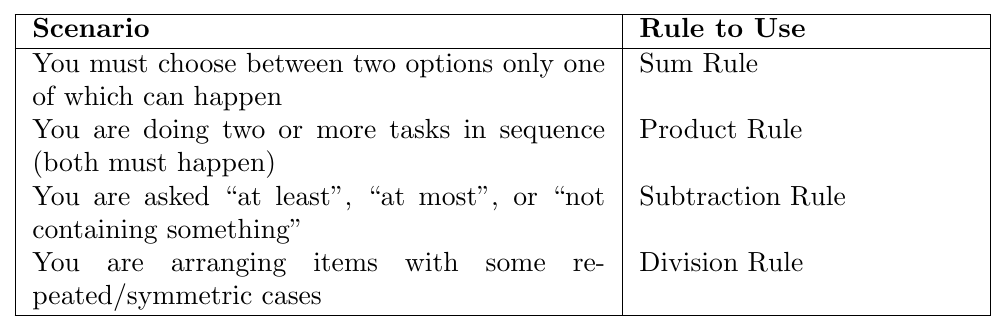
If a task can be done in $m$ ways or $n$ ways (but not both), then the total number of ways to do the task is $m + n$.
You can take a bus (5 options) or a train (3 options) to reach a city.
Solution: Since these are mutually exclusive choices: \[ \text{Total ways} = 5 + 3 = \boxed{8} \]
If a task consists of two steps, where the first step can be done in $m$ ways and the second in $n$ ways, then the total number of ways of doing the task is $m \times n$.
You want to choose a shirt (4 choices) and a pant (5 choices).
Solution: \[ \text{Total outfits} = 4 \times 5 = \boxed{20} \]
To count the number of outcomes that satisfy a condition, subtract from the total the number of outcomes that do not satisfy it.
How many 2-digit numbers (10–99) do not contain the digit 7?
Solution: Total 2-digit numbers $= 90$.
Numbers that contain digit 7 $=$ Numbers with 7 in tens place $+$ Numbers with 7 in ones place $-$ Double counted (77).
$= 10 + 9 - 1 = 18$.
Therefore, numbers without 7 $= 90 - 18 = 72$.
If a task can be done in $n$ ways and there are $k$ indistinguishable repetitions for each outcome, then the actual number of distinct outcomes is $\dfrac{n}{k}$.
In a class of 4 students \(A,B,C,D\), how many distinct 2-person teams can be formed? (Here, the team \(\{A,B\}\) is the same as \(\{B,A\}\).)
Solution: First count ordered selections: \(4\times3=12\).
Each unordered team is counted twice (\(A,B\) and \(B,A\)). By the Division Rule, divide by \(2\):
\[ \frac{12}{2} = \boxed{6} \]
So there are \(\boxed{6}\) distinct 2-person teams.
Permutations
Permutations refer to the arrangement of objects in a specific order. It is used when the order matters.
If we are given \( n \) distinct objects and we want to arrange \( r \) of them in a sequence, the number of such arrangements (permutations) is given by:
\[ P(n, r) = \frac{n!}{(n - r)!} \]
How to Identify Permutation Problems
A problem involves permutations if:
The order or arrangement matters.
You are asked to “arrange,” “order,” “line up,” or form “different sequences.”
There are restrictions about positioning (like certain people must be together or not together).
Examples of Permutation Problems
Example 1: Simple Permutation
How many different ways can 4 students be seated in 4 chairs?
Solution: Since all 4 students are seated, the number of ways = \( P(4, 4) = 4! = 24 \)
Example 2: Permutation of a Subset
In how many ways can 3 students be selected and arranged from a group of 6?
Solution: \( P(6, 3) = \frac{6!}{(6-3)!} = \frac{720}{6} = 120 \)
Example 3: Digits in a Number
How many 3-digit numbers can be formed using the digits 1, 2, 3, 4, 5 with no repetition?
Solution: Choose and arrange 3 digits from 5: \( P(5, 3) = \frac{5!}{2!} = 60 \)
Example 4: Arrangement with Restrictions
How many ways can 4 books be arranged on a shelf if one specific book must always be at the end?
Solution: Fix the specific book at the end. Now arrange the remaining 3 books: \( 3! = 6 \)
Example 5: Circular Permutations
In how many ways can 5 people be seated around a circular table?
Solution: Circular permutations: \( (n - 1)! = 4! = 24 \)
Example 6: Permutations with Repeated Items
How many permutations can be formed from the letters of the word LEVEL?
Solution: Total letters = 5; Repeated letters: L (2), E (2)
\[ \text{Permutations} = \frac{5!}{2! \cdot 2!} = \frac{120}{4} = 30 \]
Example 7: At Least Condition
From 7 people, how many ways can a president, vice president, and secretary be chosen?
Solution: These are distinct positions; order matters: \( P(7, 3) = \frac{7!}{4!} = 210 \)
Example 8: Arrangement with Items Together
In how many ways can the letters of the word SCHOOL be arranged such that S and C are together?
Solution: Treat SC as one unit. So we have: [SC], H, O, O, L → 5 letters
But O is repeated.
\[ \text{Arrangements} = \frac{5!}{2!} = \frac{120}{2} = 60 \]
Also SC and CS both allowed → multiply by 2: \( 60 \times 2 = 120 \)
Example 9: Number with Constraints
How many 4-digit numbers can be formed using the digits 1 to 6, such that the number starts with an odd digit?
Solution: Odd digits: 1, 3, 5 → 3 choices for first digit
Remaining 3 digits from 5 unused digits: \( P(5, 3) = 60 \)
Total = \( 3 \times 60 = 180 \)
Example 10: All Letters Used with Restrictions
How many ways can the letters of the word APPLE be arranged if P’s must be together?
Solution: Treat PP as a block → Remaining: [PP], A, L, E → 4 elements
\[ \text{Arrangements} = 4! = 24 \]
Example 11: Repeated Digits Constraint
How many 5-digit numbers can be formed using digits 1–5 such that no digit repeats and the number is even?
Solution: For a number to be even, it must end in 2 or 4.
Case 1: Last digit is 2 → Remaining 4 digits from {1,3,4,5}: \(4!\)
Case 2: Last digit is 4 → Remaining digits {1,2,3,5}: \(4!\)
\[ \text{Total} = 2 \times 4! = 2 \times 24 = \boxed{48} \]
Example 12: Vowels Together
How many ways can the letters of the word ENGINEER be arranged so that all vowels are together?
Solution: Vowels = E, I, E, E → 4 vowels (E repeated 3 times) Consonants = N, G, N, R → 4 consonants (N repeated 2 times)
Treat vowels as one block → total blocks = 5
\[ \text{Ways to arrange blocks} = \frac{5!}{2!} = 60 \] \[ \text{Vowel arrangements} = \frac{4!}{3!} = 4 \]
\[ \text{Total} = 60 \times 4 = \boxed{240} \]
Example 13: At Least One Condition
How many 4-digit numbers can be formed using digits 0-9 such that no digit repeats and at least one digit is 7?
Solution: Total 4-digit numbers with distinct digits:
- Thousands digit: 1–9 → 9 options - Remaining 3 digits from remaining 9 digits → \( P(9,3) \)
\[ \text{Total} = 9 \times P(9,3) = 9 \times 504 = 4536 \]
Now, subtract those without 7:
- Choose 4 digits from {0–9} excluding 7 → 9 digits - Thousands place $\neq$ 0 $\implies$ valid starting digits = 8 options (excluding 0 and 7) - Remaining 3 digits: choose from remaining 8
\[ \text{Without 7} = 8 \times P(8,3) = 8 \times 336 = 2688 \]
\[ \text{With at least one 7} = 4536 - 2688 = \boxed{1848} \]
Example 14: Positions Fixed
In how many ways can 6 people be arranged in a row if 2 particular people (A and B) must always occupy the first and last positions (in any order)?
Solution: A and B can be in (1st,6th) or (6th,1st) → 2 ways Remaining 4 people can be arranged in \(4!\)
\[ \text{Total} = 2 \times 4! = 2 \times 24 = \boxed{48} \]
Example 15: Word Arrangement with Restrictions
How many arrangements of the word ASSASSIN are there such that no two S’s are adjacent?
Solution: Total letters = 8 S appears 4 times.
First, arrange the non-S letters: A, A, I, N → 4 letters Arrangements = \( \frac{4!}{2!} = 12 \)
Place 4 S's in the 5 available gaps between/around non-S's: _ A _ A _ I _ N _ → 5 positions
Choose 4 positions out of 5 for S’s: \( \binom{5}{4} = 5 \)
\[ \text{Total} = 12 \times 5 = \boxed{60} \]
Example 16: Conditional Digit Use
How many 3-digit numbers can be formed using digits 2, 3, 4, 5, 6, 7 such that 5 is always used and digits are not repeated?
Solution: Total 3-digit numbers using digits from set of 6.
We fix 5 in one position. Then choose 2 more from remaining 5 digits.
Case 1: 5 at hundreds place → choose 2 digits from 5 → \(P(5,2) = 20\)
Case 2: 5 at tens place → hundreds digit $\neq$ 0, 5 → choose from 5 digits (excluding 5), then one more from remaining 4 → \(5 \times 4 = 20\)
Case 3: 5 at units place → similar → \(5 \times 4 = 20\)
\[ \text{Total} = 20 + 20 + 20 = \boxed{60} \]
Example 17: Circular Permutation with a Gap Constraint
In how many distinct ways can 8 different people be seated around a circular table if persons \(A\) and \(B\) have exactly two people sitting between them?
Solution: Fix \(A\)'s position to remove rotational symmetry. Around the circle, \(B\) must be placed so that exactly two seats lie between \(A\) and \(B\). There are \(2\) such positions for \(B\) (clockwise or counterclockwise).
Arrange the remaining \(6\) people in the remaining seats: \(6!\) ways.
\[ \text{Total} = 2 \times 6! = 2 \times 720 = \boxed{1440}. \]
Example 18: Permutations with Restricted Positions
In how many ways can 6 people be arranged in a row if person $A$ must be in one of the two end positions?
Solution: First, choose the position for $A$: There are \(2\) choices (left end or right end).
The remaining \(5\) people can be arranged in any order in the remaining \(5\) seats: \(5! = 120\) ways.
\[ \text{Total arrangements} = 2 \times 120 = \boxed{240}. \]
Example 19: Permutation with Minimum Gap
How many ways can the letters of EXAMPLE be arranged such that no two vowels are adjacent?
Solution: Vowels = E, A, E → total = 3 (E repeated twice)
Consonants = X, M, P, L → 4 letters
Arrange consonants: \(4! = 24\)
Now place 3 vowels in gaps between consonants: _ C _ C _ C _ C _ → 5 gaps
Choose 3 of 5 gaps: \( \binom{5}{3} = 10 \)
Vowel arrangements = \( \frac{3!}{2!} = 3 \)
\[ \text{Total} = 24 \times 10 \times 3 = \boxed{720} \]
Example 20: Arrangements with Fixed Distance
How many ways can 5 boys and 3 girls be seated in a row such that no two girls sit together?
Solution: First, place 5 boys: \(5! = 120\)
Gaps between boys = 6 positions: _ B _ B _ B _ B _ B _
Choose 3 gaps from 6 to place girls: \( \binom{6}{3} = 20 \)
Arrange girls in those positions: \(3! = 6\)
\[ \text{Total} = 120 \times 20 \times 6 = \boxed{14400} \]
Example 21: Permutations with Banned Positions
In how many ways can the letters of the word HUNTER be arranged such that the word does not start with H?
Solution: Total arrangements = \(6! = 720\)
Fix H at first position: Remaining 5 letters → \(5! = 120\)
\[ \text{Valid arrangements} = 720 - 120 = \boxed{600} \]
Example 22: Permutations with Digit Reuse Prohibited
How many 4-digit numbers greater than 3000 can be formed using digits 2, 3, 4, 5, 6 without repetition?
Solution: Thousands digit must be 3, 4, 5, or 6 (4 options) Then choose 3 more digits from remaining 4 → \(P(4,3) = 24\)
\[ \text{Total} = 4 \times 24 = \boxed{96} \]
Example 23: Permutations with Specific Characters Together
In how many ways can the letters of the word COMMITTEE be arranged such that all T’s are together?
Solution: Letters = 9; Repeats: M(2), T(2), E(2)
Treat TT as a block → 8 items: C, O, M, M, I, TT, E, E
\[ \text{Total} = \frac{8!}{2! \cdot 2! \cdot 1!} = \frac{40320}{4} = \boxed{10080} \]
Example 24: At Least One Fixed Digit
How many 4-digit numbers can be formed from digits 1 to 9 such that digit 5 appears at least once?
Solution: Total 4-digit numbers using 1–9 (no 0): \(9 \times 8 \times 7 \times 6 = 3024\)
Exclude numbers without 5:
- Choose 4 digits from 8 (excluding 5): \(P(8,4) = 1680\)
\[ \text{With at least one 5} = 3024 - 1680 = \boxed{1344} \]
Example 25: Group Arrangements with Subgroup Together
In how many ways can 5 boys and 3 girls be seated in a row such that all the girls sit together?
Solution: Treat the 3 girls as a block → now 6 "people" to arrange → \(6! = 720\)
Girls within their block can be arranged in \(3! = 6\)
\[ \text{Total} = 720 \times 6 = \boxed{4320} \]
Example 26: Letter Arrangement with Repetition and Restrictions
How many arrangements of the word BALLOON can be made such that both L’s are not together?
Solution: Total arrangements without restriction: Letters = 7; L(2), O(2)
\[ \text{Total} = \frac{7!}{2! \cdot 2!} = \frac{5040}{4} = 1260 \]
Now count cases where L’s are together:
Treat LL as a block → total = 6 items: B, A, LL, O, O, N O(2): \[ \text{With L’s together} = \frac{6!}{2!} = 360 \]
\[ \text{Not together} = 1260 - 360 = \boxed{900} \]
Example 27: Permutation with Parity Constraints
How many 3-digit even numbers can be formed using digits 2, 3, 4, 5, 6 with no digit repeated?
Solution: Even numbers end in 2, 4, or 6 → 3 cases
Case 1: End with 2 → choose 2 digits from {3,4,5,6} → \(P(4,2) = 12\)
Case 2: End with 4 → {2,3,5,6} → \(P(4,2) = 12\)
Case 3: End with 6 → {2,3,4,5} → \(P(4,2) = 12\)
\[ \text{Total} = 3 \times 12 = \boxed{36} \]
Example 28: Multiset with At Least Condition
From the word STATISTICS, how many distinct arrangements are there where all S’s are together?
Solution: Letters: 10; S(3), T(3), I(2), A(1), C(1)
Group all S’s → treat as a block: 8 items: SSS, T(3), I(2), A, C
\[ \text{Total} = \frac{8!}{3! \cdot 2!} = \frac{40320}{12} = \boxed{3360} \]
Example 29: Permutations with Min Distance Constraint
How many ways can 6 people be seated in a row such that A and B have exactly one person between them?
Easy Solution (Position Method): Valid seat pairs for A and B with exactly one seat between them are: \((1,3),(2,4),(3,5),(4,6)\) — \(\;4\) pairs.
For each pair: - A and B can swap places: \(\;2\) ways. - Choose who sits between them: from the remaining \(4\) people: \(\;4\) ways. - Arrange the remaining \(3\) people in the remaining \(3\) seats: \(\;3! = 6\) ways.
\[ \text{Total} = 4 \times 2 \times 4 \times 3! = 4 \times 2 \times 4 \times 6 = \boxed{192}. \]
(Quick Check) Alternatively, fix a valid pair (e.g., \(1,3\)) and order A/B in \(2\) ways; then the other \(4\) people fill the remaining seats in \(4! = 24\) ways. So \(4 \times 2 \times 24 = \boxed{192}\).
Example 30: Distribution of Items in Permutations
In how many ways can 5 identical red balls and 4 identical green balls be arranged in a row?
Solution: Total objects = 9 Red balls identical, Green balls identical
\[ \text{Total arrangements} = \frac{9!}{5! \cdot 4!} = \frac{362880}{120 \cdot 24} = \boxed{126} \]
Combinations
In combinatorics, a combination is a selection of items where the order does not matter.
The number of combinations of \( r \) items that can be selected from \( n \) distinct items is given by: \[ ^nC_r = \binom{n}{r} = \frac{n!}{r!(n-r)!} \]
When to Identify a Problem as Combination
Use combinations when:
The selection is made without regard to order.
Groupings or committees are formed.
No specific arrangement or position is mentioned.
Avoid using permutations unless the sequence/arrangement matters.
Examples of Combinations
Example 1: Committee Selection
From a group of 10 people, how many ways can we select 4 to form a committee?
Solution: \[ \binom{10}{4} = \frac{10!}{4! \cdot 6!} = \frac{5040}{24} = \boxed{210} \]
Example 2: Handshake Problem
In a party of 12 people, if each person shakes hands with every other person once, how many handshakes occur?
Solution: Each handshake is a combination of 2 people: \[ \binom{12}{2} = \frac{12 \cdot 11}{2} = \boxed{66} \]
Example 3: Choosing Balls
From a bag of 15 balls, how many ways can 6 balls be drawn simultaneously?
Solution: Order doesn't matter: \[ \binom{15}{6} = \boxed{5005} \]
Example 4: Forming Teams
A class has 8 boys and 7 girls. In how many ways can a team of 5 students be chosen such that it includes at least 2 girls?
Solution: We sum combinations for cases:
2 girls, 3 boys: \(\binom{7}{2} \cdot \binom{8}{3} = 21 \cdot 56 = 1176\)
3 girls, 2 boys: \(\binom{7}{3} \cdot \binom{8}{2} = 35 \cdot 28 = 980\)
4 girls, 1 boy: \(\binom{7}{4} \cdot \binom{8}{1} = 35 \cdot 8 = 280\)
5 girls: \(\binom{7}{5} = 21\)
Total = \(1176 + 980 + 280 + 21 = \boxed{2457}\)
Example 5: Card Selection
How many 5-card hands can be drawn from a deck of 52 cards?
Solution: \[ \binom{52}{5} = \boxed{2,598,960} \]
Example 6: Dividing Prizes
In how many ways can 3 identical prizes be given to 10 students?
Solution: Choose 3 students from 10: \[ \binom{10}{3} = \boxed{120} \]
Example 7: Selecting Questions
Out of 20 questions in an exam, a student must attempt 15. In how many ways can this be done?
Solution: \[ \binom{20}{15} = \binom{20}{5} = \boxed{15504} \]
Example 8: Subsets
How many subsets of 4 elements can be formed from a set of 10 elements?
Solution: \[ \binom{10}{4} = \boxed{210} \]
Example 9: Lottery Selection
A lottery draws 6 numbers out of 49. How many combinations are possible?
Solution: \[ \binom{49}{6} = \boxed{13,983,816} \]
Example 10: Choosing Books
From 12 different books, in how many ways can 5 books be selected for reading?
Solution: \[ \binom{12}{5} = \boxed{792} \]
In how many ways can a committee of 4 people be selected from 7 men and 5 women such that the committee contains at least 2 women?
Solution:
We consider all valid combinations: \[ \begin{aligned} &\text{2 women, 2 men: } \binom{5}{2} \cdot \binom{7}{2} = 10 \cdot 21 = 210 \\ &\text{3 women, 1 man: } \binom{5}{3} \cdot \binom{7}{1} = 10 \cdot 7 = 70 \\ &\text{4 women: } \binom{5}{4} = 5 \end{aligned} \]
\[ \text{Total} = 210 + 70 + 5 = \boxed{285} \]
From a group of 10 people, in how many ways can a team of 5 be formed such that two particular persons are never together?
Solution:
Let the two particular persons be A and B.
Total combinations without any restriction: \(\binom{10}{5} = 252\)
Number of teams where A and B are together: Choose A and B (fixed), then choose 3 more from remaining 8: \[ \binom{8}{3} = 56 \]
Required: \(252 - 56 = \boxed{196}\)
Question: For a game in which two partners oppose two other partners, a total of \(6\) men are available. If every possible pair must play with every other pair, how many games are played?
Solution:
We interpret a "game" as selecting two disjoint unordered pairs (pair A vs pair B). Each distinct unordered pair-of-pairs corresponds to one game.
Method 1 (choose pairs stepwise):
Choose the first pair of players: there are \[ \frac{6\times5}{2\times1}=15 \] ways to pick 2 out of 6.
From the remaining 4 men choose the opposing pair: \[ \frac{4\times3}{2\times1}=6 \] ways.
The ordered choice (first pair, then second pair) counts each matchup twice (pair \(P\) vs \(Q\) and pair \(Q\) vs \(P\) are the same game), so divide by 2: \[ \frac{15\times 6}{2} = 45. \]
Method 2 (choose 4 players then partition):
Choose which 4 of the 6 men will play in a particular game: \[ \frac{6\times5\times4\times3}{4\times3\times2\times1}=15 \] ways.
For those 4 chosen players, count the number of ways to split them into two unordered pairs. The pairings of 4 distinct people into two unordered pairs equals \(3\) (you can check: fix one person, they have 3 choices for partner, then remaining 2 form the other pair; divide by 2 to remove order of the two pairs: \(\tfrac{3}{1}=3\)).
Multiply: \[ 15 \times 3 = 45. \]
\[ \boxed{45} \]
Answer: \(\boxed{45}\) games.
A question paper has 10 questions. A student has to answer exactly 7. However, questions 1 and 2 are mutually exclusive (i.e., both cannot be selected together). In how many ways can the student choose 7 questions?
Solution:
Case 1: Choose Q1 but not Q2 → choose 6 from remaining 8: \(\binom{8}{6} = 28\)
Case 2: Choose Q2 but not Q1 → again, \(\binom{8}{6} = 28\)
Case 3: Choose neither Q1 nor Q2 → choose 7 from remaining 8: \(\binom{8}{7} = 8\)
Total = \(28 + 28 + 8 = \boxed{64}\)
How many ways can you choose a group of 6 people from 12 such that two particular people are either both in or both out of the group?
Solution:
Let A and B be the two particular people.
Case 1: Both A and B are in: choose 4 more from 10 → \(\binom{10}{4} = 210\)
Case 2: Both A and B are out: choose 6 from 10 → \(\binom{10}{6} = 210\)
Total = \(210 + 210 = \boxed{420}\)
From 8 different books, how many ways can 5 be chosen such that at least one specific book is included?
Solution:
Total ways without restriction: \(\binom{8}{5} = 56\)
Ways that exclude the specific book: \(\binom{7}{5} = 21\)
Required: \(56 - 21 = \boxed{35}\)
From 9 items, including 3 identical ones, how many distinct sets of 4 items can be chosen?
Solution:
We count based on how many of the identical items are included.
Case 1: 0 identical → choose 4 from 6 distinct: \(\binom{6}{4} = 15\)
Case 2: 1 identical → \(\binom{6}{3} = 20\)
Case 3: 2 identical → \(\binom{6}{2} = 15\)
Case 4: 3 identical → \(\binom{6}{1} = 6\)
Total = \(15 + 20 + 15 + 6 = \boxed{56}\)
How many ways can a team of 4 be formed from 6 girls and 4 boys such that the team includes more girls than boys?
Solution:
Valid compositions: - 3 girls, 1 boy → \(\binom{6}{3} \cdot \binom{4}{1} = 20 \cdot 4 = 80\) - 4 girls → \(\binom{6}{4} = 15\)
Total = \(80 + 15 = \boxed{95}\)
From 12 students, how many ways can 5 be chosen such that two specific students are not both included?
Solution:
Total combinations: \(\binom{12}{5} = 792\)
Combinations with both A and B: Choose 3 more from 10 → \(\binom{10}{3} = 120\)
Required: \(792 - 120 = \boxed{672}\)
From 6 red, 5 green, and 4 blue balls, how many ways can 5 balls be selected with at least one of each color?
Solution:
We count cases with at least one red, one green, one blue.
Approach: Use generating functions or inclusion-exclusion, but simpler to manually count valid (r, g, b) combinations that sum to 5 with each \(\geq 1\):
Possible (r, g, b) combinations:
- (3,1,1): \(\binom{6}{3} \cdot \binom{5}{1} \cdot \binom{4}{1} = 20 \cdot 5 \cdot 4 = 400\) - (2,2,1): \(\binom{6}{2} \cdot \binom{5}{2} \cdot \binom{4}{1} = 15 \cdot 10 \cdot 4 = 600\) - (2,1,2): \(15 \cdot 5 \cdot 6 = 450\) - (1,3,1): \(6 \cdot 10 \cdot 4 = 240\) - (1,2,2): \(6 \cdot 10 \cdot 6 = 360\) - (1,1,3): \(6 \cdot 5 \cdot 4 = 120\)
Total = \(400 + 600 + 450 + 240 + 360 + 120 = \boxed{2170}\)